// ARCHITECTURE INDEX
01 // MECHANICAL KINEMATIC SEPARATION
Sherpa Systems Steering Architecture
Traditional industrial carts rely on Ackerman or skid-steer designs. In unpaved settings, Ackerman geometry forces wide turning radiuses that waste yard space, while skid-steer systems drag tires laterally, damaging surfaces and wearing components rapidly.
Sherpa Systems eliminates this compromise through an innovative steering architecture that decouples cart orientation from cargo platform dynamics. The result: precision maneuvering in tight spaces, zero surface scuffing, and dramatically extended drivetrain life.
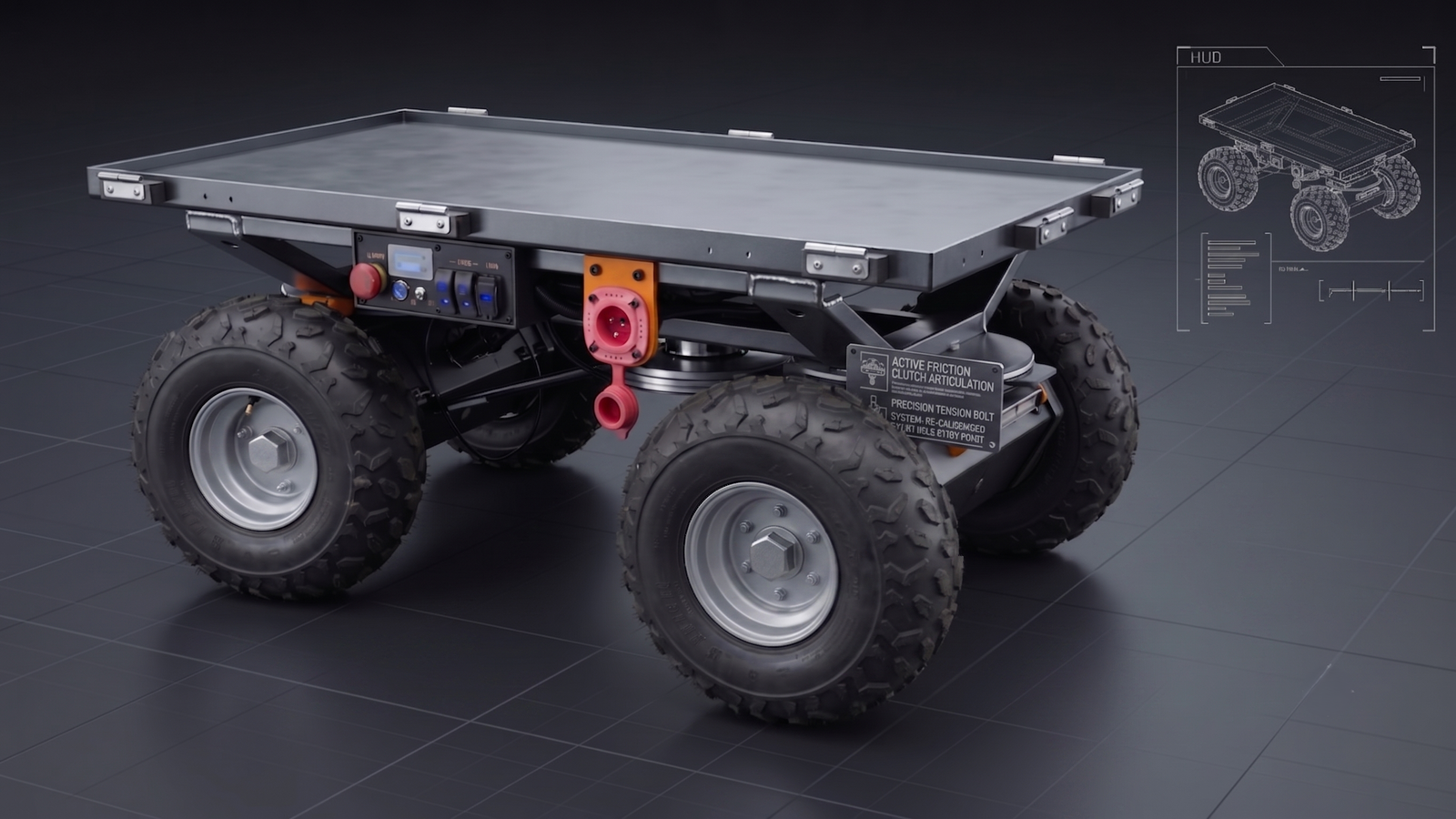
CRITICAL MECHANICS: The structural main chassis and upper cargo pan remain completely stationary during directional updates. Because the payload platform does not rotate with the front axle, the payload stays flat and balanced—completely eliminating cargo shifting even during a sharp 360-degree pivot in place.
02 // DISTRIBUTED TORQUE MANAGEMENT
Independent Real-Time Differential Velocity
Rather than depending on mechanical linkages or steering knuckles to force a turning arc, directional steering changes are driven programmatically. The system controls direction by managing wheel-speed differentials across the front axle.
Our proprietary algorithmic framework calculates and distributes precise torque profiles to each independent wheel hub motor. When executing a zero-radius turn, the wheels do not roll along an arc; instead, they are driven at variable, opposing velocities to rotate the axle around its exact center point.
This approach ensures continuous forward traction, eliminates tire drag, and minimizes turf scuffing and path damage on loose or unpaved industrial surfaces.
03 // SUB-SYSTEM ISOLATION HARDENING
Marine-Grade Physical Hardening
Precision kinematics require an equally rugged electrical and environmental containment system. Every component of our drivetrain architecture is hardened against severe outdoor conditions.
- // ENCLOSURES: Full IP65/IP67 certified sub-assembly containment.
- // THERMALS: High-current motor controllers utilize external, passive heavy-gauge aluminum heat-sinks, completely eliminating active cooling fans that ingest dust and debris.
- // INTERCONNECTS: Heavy-duty shielded marine cabling paired with vibration-dampened sensor housings blocks internal EMI and RFI signal degradation.